



CQ | The AI That Gives Wings to Robots: How MIT Increased the Speed of Flying Robots by 4.5 Times
⚡ Reper CorpQuants: AI algorithms not only optimize digital processes, but can revolutionize the control of physical robots, delivering unmatched performance for industrial and emergency applications.
What happens when artificial intelligence meets cutting-edge hardware? A flying robot developed at MIT has shattered speed and agility barriers, now performing complex maneuvers at a speed 4.5 times greater than before.
This technological leap is not just impressive—it paves the way for critical applications in industry and emergency response. The MIT demonstration shows that AI is no longer limited to data processing or software, but is becoming a transformative force for automating physical processes, directly impacting how robots interact with the real world.
Why AI Is Changing the Rules of the Game in Robotics
Over the past decade, artificial intelligence has revolutionized fields such as data analysis, image recognition, and natural language processing. However, the real challenge has always been transferring these advances into the physical world, where robots must react quickly, precisely, and adaptively to complex and unpredictable environments.
Traditional robot control relied on rigid mathematical models that could not successfully handle the fast and irregular dynamics of real-world environments. AI, through machine learning algorithms and intelligent control, now enables robots to anticipate, adapt, and optimize their movements in real time, approaching the performance observed in nature.
MIT Innovation: Technical Details About the Flying Robot
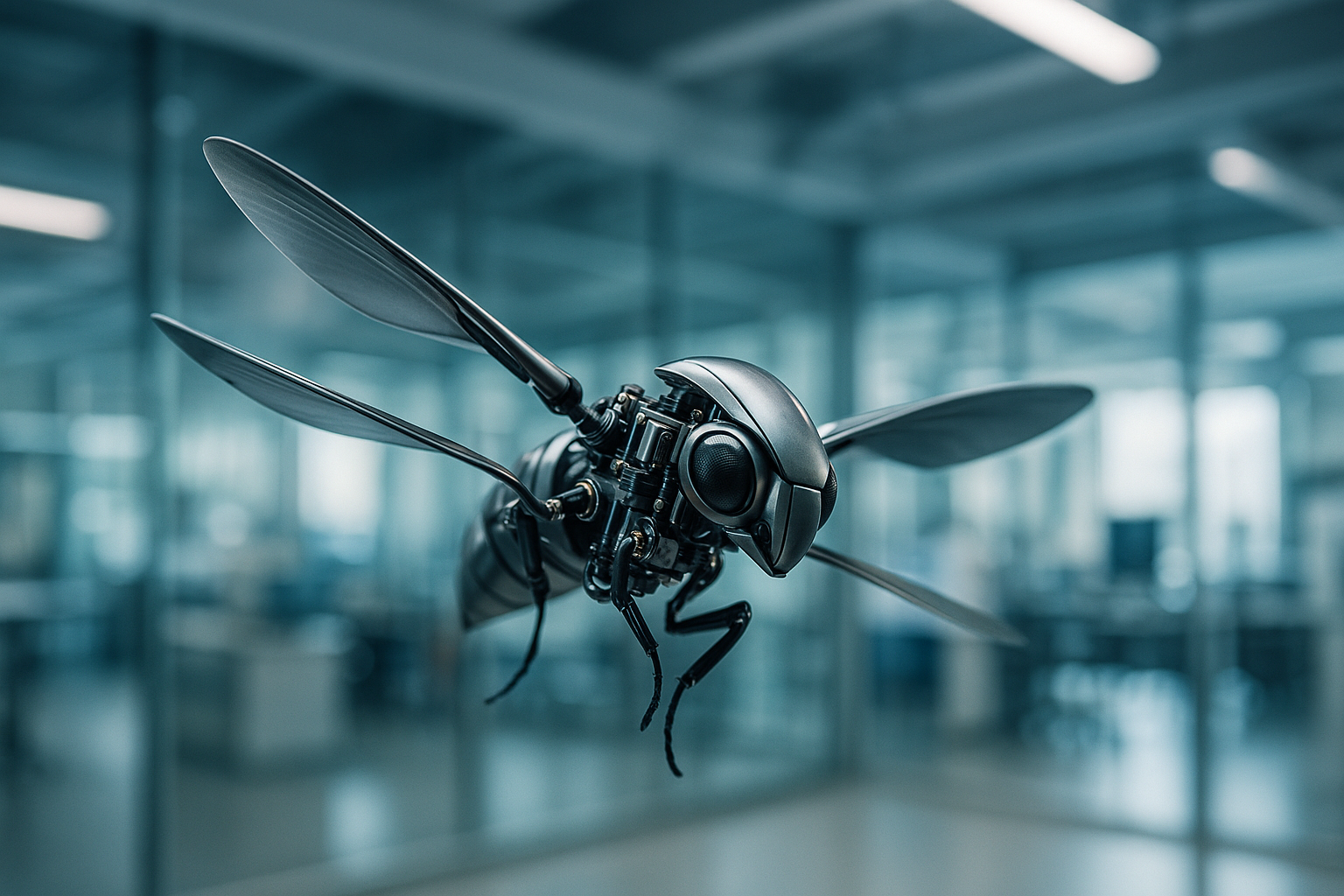
A team of researchers at the Massachusetts Institute of Technology (MIT) recently unveiled a miniature flying robot inspired by the agility of insects, which managed to increase its response speed and maneuverability by 450% compared to previous generations. The key to this performance is a new AI control system capable of rapidly processing sensor data and adjusting commands to the robot’s motors in real time.
Technically, the AI system uses neural networks optimized for aerodynamic dynamics control, combining data from accelerometers, gyroscopes, and onboard cameras. The algorithm learns to anticipate imbalances and correct the robot’s trajectory in fractions of a second, enabling extremely fast and precise maneuvers even in turbulent conditions or when facing unexpected obstacles.
Performance Comparable to Insects
- Reaction speed increased 4.5 times compared to previous systems
- Complex maneuvers (backflips, sudden changes of direction)
- Stability and adaptability in challenging environments
Practical Implications: Industrial Applications and Intervention Scenarios
The dramatic increase in the speed and agility of flying robots opens new perspectives for automation and safety in environments where human access is limited or dangerous.
Industrial Applications
- Industrial inspections: Robots can quickly navigate through narrow or hard-to-reach spaces, inspecting installations, pipelines, or structures without stopping production.
- Monitoring and maintenance: AI algorithms enable rapid identification of anomalies, reducing the risk of major failures and the costs associated with reactive maintenance.
Emergency Response
- Search and rescue in disaster zones: Flying robots can enter collapsed buildings or toxic areas, locating survivors and rapidly mapping the environment.
- Exploring hazardous spaces: In radioactive, chemical, or explosion-prone environments, AI-powered robots can carry out reconnaissance missions without endangering human lives.
What’s Next for AI and Physical Robots?
The progress demonstrated by MIT marks a new stage in the convergence between AI and robotics. In the coming years, we can expect:
- Increasingly agile autonomous robots capable of operating in ever more complex environments
- Advanced AI integration in fleets of collaborative robots for logistics, construction, or agriculture
- Development of safety and interoperability standards for AI robots in industry
As AI becomes increasingly present in the control of physical robots, the boundary between software and hardware is blurring, and opportunities for innovation and efficiency are growing exponentially. MIT has shown that, through AI, robots can achieve biological-level performance, opening a new era for intelligent automation.
(This material was assisted by an AI tool and reviewed by our team before publishing).