



CQ | AI in Companies: From the Promise of Automation to the Reality of Costs and Risks
⚡ Reper CorpQuants: Justified complexity – The optimal AI solution is not the most complex one, but the one that generates the greatest economic value at an acceptable level of cost and risk. Before implementation, compare traditional automation, a single AI agent, and multi-agent systems. Additional complexity must be justified by measurable benefits.
Artificial Intelligence can profoundly transform organizational activity. However, between technological demonstrations and achieving real economic benefits, there are significant challenges of integration, cost, and control.
Beyond Technological Enthusiasm
Generative Artificial Intelligence has created significant expectations in the corporate environment: reducing operational costs, automating processes, accelerating decision-making, and increasing productivity.
However, an AI solution that works convincingly in a pilot project is not necessarily ready for large-scale use. Integration with existing systems, data quality, recurring costs, and risk management can turn an apparently simple implementation into a complex project.
The McKinsey study The State of AI in 2025 highlights this gap: although 88% of respondents report using AI in at least one organizational function, only 39% indicate an impact on the operational result (EBIT) at the organization-wide level.
Adopting AI does not automatically translate into financial performance. Value arises when the technology is integrated into efficient processes and generates measurable benefits.
From Traditional Automation to Agentic AI Systems
The experience of RPA (Robotic Process Automation) implementations has shown that automating repetitive processes can produce significant savings, but also that technology does not automatically correct inefficient processes.
Agentic AI systems extend these possibilities. AI agents can interpret unstructured information, use applications and tools, execute tasks, and collaborate within complex workflows.
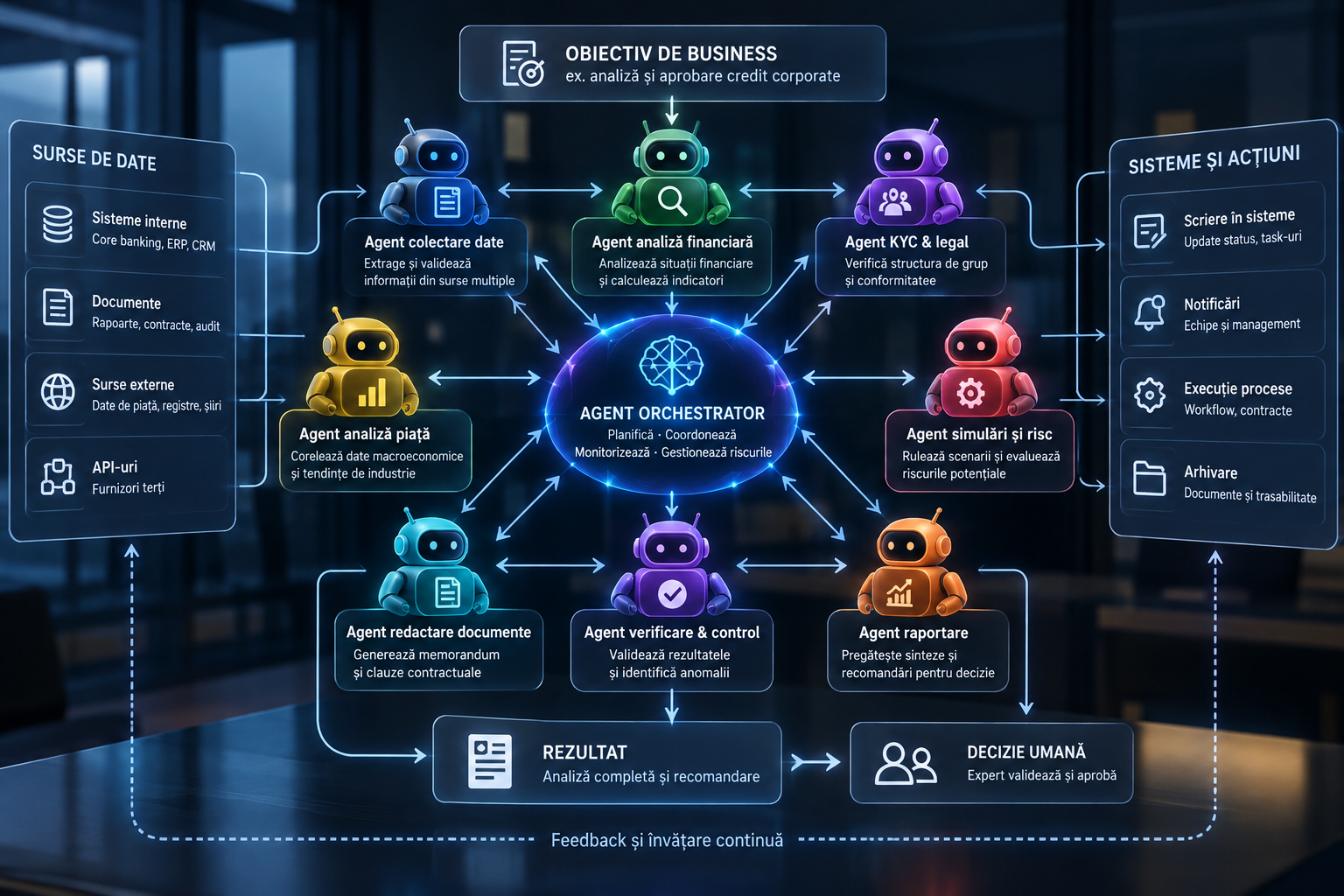
In a multi-agent architecture, different agents can take on specialized activities, transmit results, and contribute to the completion of an end-to-end process.
However, more agents do not automatically mean better results. Additional complexity can generate costs, latency, and coordination difficulties.
As Anthropic emphasizes in the guide Building Effective Agents, it is preferable to use simple architectures and introduce complexity only when it brings demonstrable benefits.
The choice between a traditional workflow, a single AI agent, and a multi-agent architecture should start from the business need, not from the sophistication of the technology.
What Does Agentic AI Look Like in Practice?
Banking: Corporate Credit Analysis
The process of granting loans to large companies involves analyzing significant volumes of financial, legal, and economic information.
An agentic AI architecture could distribute activities among specialized components:
- – Extracting and verifying information from financial statements and audit reports.
- – Analyzing group structures and identifying relevant information for KYC.
- – Calculating and interpreting financial indicators.
- – Preparing scenarios and simulations regarding repayment capacity.
- – Consolidating results into a draft credit memorandum.
Not all these activities require AI agents. Financial calculations and rating models can remain in deterministic applications, while AI can be used for document interpretation and preparing analyses.
Risk arises when misinterpreted information is passed between process stages without proper checks. An error in data extraction can affect financial indicators, projections, and the conclusions of the analysis.
Therefore, traceability of information, validation of results, and maintaining decision-making responsibility are essential.
Telecom: Infrastructure and Service Management
In telecommunications, AI agents can support incident monitoring, predictive maintenance, and coordination of interventions.
For example, different components can analyze technical alerts, identify equipment at risk of failure, correlate incidents with affected services, and prepare priority interventions.
However, processing large volumes of data and direct control of infrastructure should remain the responsibility of specialized systems when they provide more reliable and efficient solutions.
The role of AI is to improve information interpretation and process coordination, not to indiscriminately replace existing infrastructure.
Three Major Challenges in AI Implementation
1. Integration with Existing Systems
Large organizations often operate with applications developed at different times, fragmented databases, and heterogeneous integration interfaces.
AI does not automatically eliminate these limitations. On the contrary, accessing and correlating information from multiple systems can highlight issues of data quality, security, and compatibility.
Efficient implementation requires stable interfaces, data governance, and clear mechanisms for access and control.
Full modernization of infrastructure is not always necessary. A gradual approach, focused on well-defined processes, can significantly reduce costs and risks.
2. The Real Costs of Automation
The economic evaluation of AI should not be limited to comparing personnel costs with the price of using language models.
The Total Cost of Ownership (TCO) includes:
- – Initial investment: development, integration, data preparation, testing, and security.
- – Recurring costs: AI model consumption, infrastructure, monitoring, maintenance, and updates.
- – Organizational costs: technical skills, staff training, and control mechanisms.
In multi-agent architectures, costs can increase due to repeated calls to models, context transfers, and successive checks between agents.
However, savings must be realistically assessed. Reducing processing time by 40% does not automatically mean reducing costs by 40%.
Benefits may come from actual savings, increased operational capacity, or improved result quality. These effects must be measured separately.
3. Risk Control and Operational Continuity
AI systems can produce incorrect results, misinterpret information, or execute inappropriate actions if not properly configured and supervised.
In processes with significant financial or operational impact, organizations must establish clear autonomy limits, verification mechanisms, and decision-making responsibilities.
The Human-in-the-loop principle requires human intervention in relevant stages, depending on the level of risk.
At the same time, automation should not eliminate the organization’s ability to understand and control critical processes or to ensure business continuity in case of incidents.
The NIST AI Risk Management Framework and EBA documents on risks in the banking sector provide useful benchmarks for developing such governance mechanisms.
⚠️ Reper CorpQuants: How do we assess the real value of an AI investment?
Assessing the Value of AI Investment
For investment decision-making, CorpQuants proposes using a simple economic benchmark:
Risk-adjusted net value = Realizable economic benefits − Total cost of ownership − Estimated cost of residual risks
This approach targets three essential dimensions:
Value created. Actual savings, additional operational capacity, error reduction, and service improvement.
Total cost. Initial investment, recurring costs, integration, maintenance, and skills development.
Residual risk. Potential losses associated with errors, security incidents, operational disruptions, or non-compliance.
For practical application, benefits and costs must be evaluated over the same time horizon, and risks should be quantified, as much as possible, through expected losses or impact scenarios. In a multi-year business case, financial flows must be discounted to allow a fair comparison.
From this perspective, management should track indicators such as cost per operation, processing time, error rate, manual interventions, and return on investment.
An AI implementation is economically justified not by the number of agents or the degree of autonomy, but by the net value it generates under controlled risk conditions.
AI Implementation Does Not End at Launch
Contrary to the perception that an AI solution can be installed and then used without significant interventions, complex systems require continuous monitoring and improvement.
Business processes, data sources, and models used evolve. Performance can be affected by changes in the operational context, updates to integrated applications, or modifications to organizational requirements.
These situations do not always require retraining models. Sometimes, adjusting instructions, optimizing workflows, updating data, or improving validation mechanisms is sufficient.
Therefore, the budget for an implementation must cover the entire lifecycle of the solution, not just the initial development.
Conclusion: From Technological Enthusiasm to Economic Discipline
Artificial Intelligence offers significant opportunities for process automation, productivity growth, and improved decision-making.
However, adopting AI does not automatically guarantee economic efficiency. Integrating technology with existing processes, cost control, and risk management are just as important as the performance of the models used.
The organizations that will best capitalize on these technologies will not necessarily be those that implement the most complex architectures, but those that choose solutions proportional to real needs and demonstrate the benefits achieved.
AI should be evaluated by the same logic applicable to any investment: the value generated must justify the resources consumed and the risks assumed.
References
1. McKinsey & Company (2025), The State of AI in 2025 — “Report” (https://www.mckinsey.com/capabilities/growth-marketing-and-sales/our-insights/the-state-of-ai-2025).
2. Anthropic (2024), Building Effective Agents — “Technical Guide” (https://www.anthropic.com/engineering/building-effective-agents).
3. NIST (2023), Artificial Intelligence Risk Management Framework (AI RMF 1.0) — “Official Document” (https://doi.org/10.6028/NIST.AI.100-1).
4. NIST (2024), Artificial Intelligence Risk Management Framework: Generative Artificial Intelligence Profile — “Official Document” (https://doi.org/10.6028/NIST.AI.600-1).
5. European Banking Authority (2026), Risk Assessment Report – June 2026 — “EBA Report” (https://www.eba.europa.eu/publications-and-media/publications/risk-assessment-report-june-2026).
The banking and telecom examples are illustrative scenarios of agentic AI usage, not descriptions of specific implementations.
(This material was assisted by an AI tool and reviewed by our team before publishing).