



CQ | Why Gradient Descent Became Stochastic: The Evolution of Optimization in Machine Learning
⚡ Reper CorpQuants: Choosing the optimization method directly impacts the efficiency and scalability of AI models – SGD has become essential for handling large volumes of data and complex networks, surpassing the limitations of classic Gradient Descent.
Optimization is the process by which Machine Learning models learn from data, adjusting their parameters to minimize a loss function. Whether we’re talking about linear regression, neural networks, or complex deep learning models, efficient optimization determines how quickly and effectively a model can generalize to new data.
Classic Gradient Descent involves calculating the gradient of the loss function with respect to all model parameters, using the entire dataset at each update step. Thus, every iteration requires processing all examples in the dataset:
- Advantage: The optimization direction is precise and stable.
- Disadvantage: High computational cost, especially for large datasets.
For small data volumes, this method is efficient and easy to implement. However, as datasets grow to millions or billions of examples, each step becomes increasingly expensive.
Stochastic Gradient Descent (SGD)
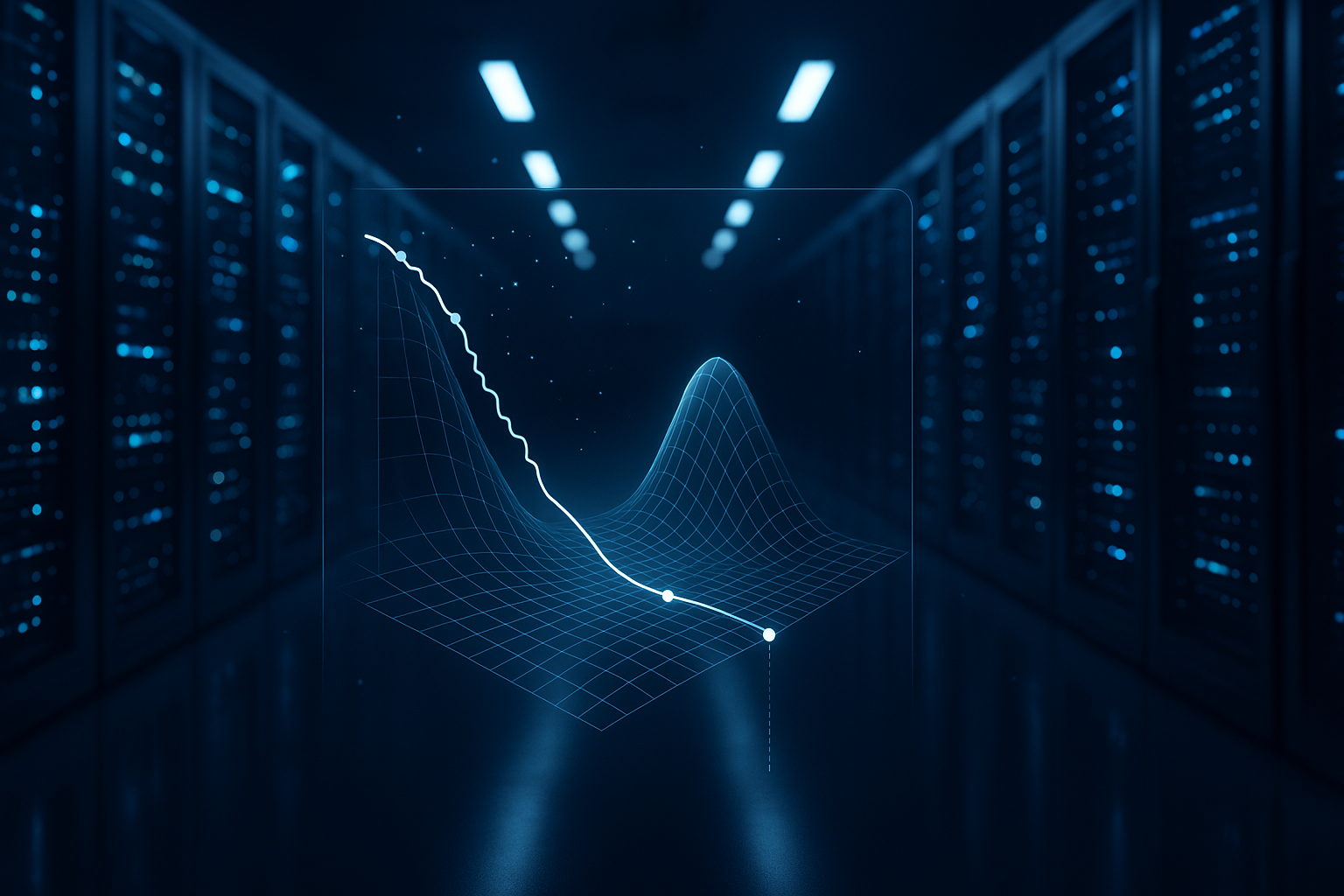
SGD radically changes the approach: instead of using the entire dataset, it updates the model parameters after each example (or mini-batch). Thus, the gradient is estimated on a small portion of data, introducing a degree of randomness (stochasticity) into the optimization process.
- Advantage: Much faster updates, allowing the processing of massive datasets.
- Disadvantage: The optimization trajectory is “noisier,” but this can help avoid local minima.
The Advantages of SGD in Practice: Performance, Scalability, and Efficiency
Why Has SGD Become the Industry Standard?
- Scalability for large data: SGD enables training models on huge datasets that classic Gradient Descent cannot practically handle.
- Faster convergence: Frequent updates accelerate learning, especially in the early stages of training.
- Better generalization: The noise introduced by SGD helps avoid overfitting and escape local minima.
- Flexibility for complex models: Deep neural networks (deep learning) would not be possible without SGD-type optimizers.
The Impact of Choosing the Optimization Method
Choosing between classic Gradient Descent and SGD is not just a technical matter, but has direct implications on infrastructure costs, training time, and result quality. In today’s context, where AI models are trained on distributed infrastructures and with massive data volumes, SGD is the de facto optimal choice.
Conclusion: Implications for the Future of AI Development
The evolution from classic Gradient Descent to Stochastic Gradient Descent reflects the AI industry’s ongoing adaptation to the challenges of big data and increasingly complex models. SGD is not just a technical choice, but a fundamental pillar enabling the scaling and efficiency of the training process in modern Machine Learning.
For professionals and managers, understanding these differences is crucial for making informed decisions regarding AI architecture, infrastructure, and development strategy. As models become more sophisticated, the correct selection and configuration of optimization algorithms will remain a key factor in the success of artificial intelligence projects.
(This material was assisted by an AI tool and reviewed by our team before publishing).